
One inch of rain puts about 1,743 gallons of water on a 40 by 70 foot roof, according to the USGS. Every drop needs a clear route: off the roof, into the gutter, down the downspout and away from your foundation.
Most winter leaks happen where that route breaks down. A long, heavy storm will find every weak point.
Flashing where roof meets wall
Wherever a lower roof runs into a wall, such as at a dormer, a second story addition, a chimney or a porch roof, there should be metal flashing that guides water off the wall and onto the roof.
To work properly, that flashing has to tuck behind the siding. Flashing that was simply nailed on top and caulked can hold up for years, then fail in the first long storm.
Watch for stained or swollen siding just above a roofline, paint peeling in a diagonal band, and water stains on the inside wall below. We wrote about a real example in When a New Roof Requires New Siding, where the siding had to come off so the roofer could install the flashing correctly.
One small piece of metal does a lot of work at the bottom of that flashing, where the edge of a roof runs into a wall. It’s called a kickout flashing. It turns the water out into the gutter instead of letting it pour down the face of the wall. The California Residential Code calls for one there. Plenty of older houses never got one, and plenty of reroofs left it out. From the ground, look at the wall just below the spot where a lower roof edge meets it. A dark streak, peeling paint or a soft board there usually means the kickout is missing.


Four quick gutter checks
- Clean them once the leaves drop, and again midwinter if you have oaks or other trees overhead.
- Look for standing water. It means the gutter is sagging or tilted the wrong way.
- Check the brackets. A gutter pulling away from the house spills water behind itself, right onto the wood.
- Look for drips at the seams and end caps.

Downspouts
A downspout that empties at the base of the wall dumps an entire roof’s worth of water against your foundation. Make sure each one carries water well away from the house, onto ground that slopes away, or into a drain line that’s actually clear.
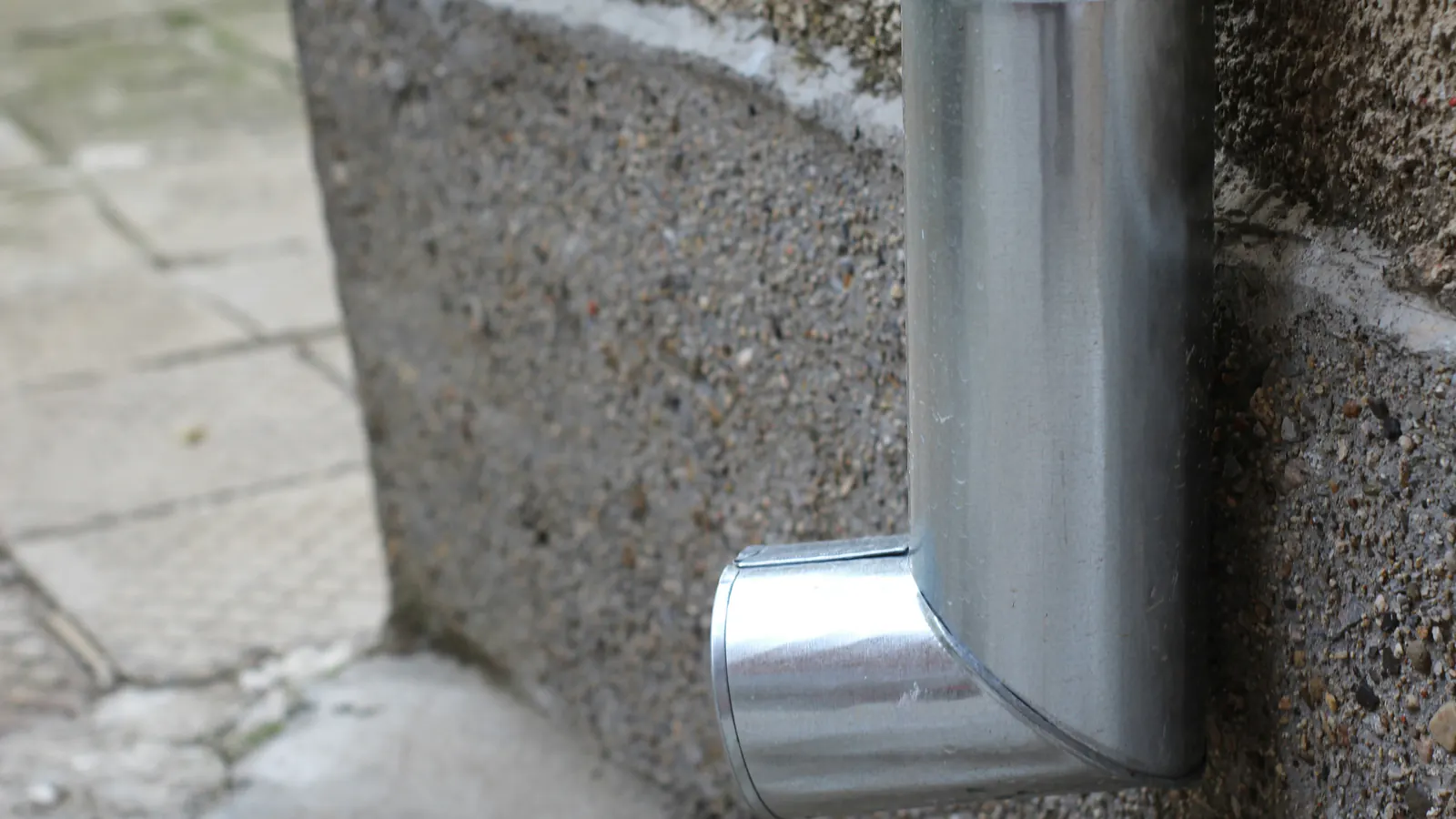
Finding a downspout that dumps at the wall
You don’t need a storm to find one. Walk the house on a dry day and look at the ground under each downspout.
- Bare, washed out soil or a small crater under the outlet means the water lands hard and stays next to the wall.
- A white, powdery crust on the concrete foundation is mineral salt left behind by water soaking through it and drying out again.
- Moss or green algae on the foundation or the bottom of the siding means that spot rarely dries.
- A downspout that runs into a pipe in the ground needs a look at the other end. Find where the pipe comes out, at the curb or in the yard. If you can’t find an outlet, or water bubbles up at the base of the downspout in a storm, the buried line is likely crushed or full of roots.
Most of these take an extension long enough to put the water past the planting bed, onto ground that falls away from the house. The California Residential Code asks a new house for 6 inches of fall in the first 10 feet out from the foundation, which gives you a sense of the slope it takes. If the ground beside your house is flat or runs toward it, an extension won’t be enough. The drainage then needs a design from a civil engineer or a drainage contractor.

Who handles what
We manage the whole job and plan the work so your siding comes off once and goes back on once. Our crews remove and replace siding and trim, repair rot, and handle paint and caulk once the flashing is right. We repair the flashing itself and small roof leaks too. A re-roof or anything structural goes to a licensed roofer we bring in. Our licensed plumbing partner handles sump pumps and drain lines. For grading, French drains and anything underground, we’ll help you find the right engineer.
Before the next storm
- Walk every downspout outlet and look for the signs above. Note each one that lands within a step of the wall.
- From the ground, look along each gutter for sags, seams that drip and spots where it has pulled away from the house. Binoculars help on a second story.
- Look at the wall below every place a lower roof meets it. A streak or a soft board there points to the flashing above it.
- Check the trim board the gutter hangs on (the fascia) for peeling paint. Water that spills over the back of a gutter rots it from the top edge down.
- Clear leaves and silt out of every yard drain you can reach without tools.
Downspout extensions, splash blocks and yard drains are yours. Cleaning a one story gutter from a stepladder is a homeowner job on a dry, calm day. Second story gutters, anything on the roof, and all flashing are not. A missing kickout is the expensive one to put off. The water it lets in runs down inside the wall, where nobody sees it until the wood at the bottom has gone soft.
My gutters overflow in the heaviest storms, but not in normal rain. Should I worry?
It depends on where the water lands. If it runs down your siding or splashes against the foundation, it’s worth fixing. Sometimes a bigger downspout or an extra outlet is all it takes.
Can caulk fix a flashing leak?
Sometimes, for a little while. It isn’t a lasting fix for flashing that was installed wrong. We’d rather tell you that now than after a stain shows up on your ceiling.
See our exterior upgrades and carpentry services, or request an estimate.